
Can something be literally impossible to understand?
Not just hard or complex, but utterly beyond comprehension.

We’ve all wrestled with ideas that are difficult (perhaps advanced math or a stubborn puzzle), but what about concepts that no human brain could ever understand? These wouldn't be ideas that are merely confusing or overwhelmingly complex. These would be ideas that are fundamentally impossible to grasp. I’m not referring to random nonsense. I mean genuinely useful insights, explanations that could illuminate our view of the universe, yet the human mind is simply not equipped to understand them.
Put another way: Could there be ideas so alien to our cognition that they remain absolutely incomprehensible to us, yet would prove profoundly valuable if only we could grasp them?
An earlier version of this article was published on Medium. This version has been revised for clarity and flow.
Cats and doors
As I write this during the COVID pandemic, my wife is in the office on a Zoom call with the door closed. It’s not latched, and a light push would open the door. Unfortunately, our cat doesn’t understand how to push the door open, so she is sitting in the hallway meowing loudly to be let in.
If the door were open just a crack, then she would try to squeeze through the crack, inadvertently pushing the door open. She knows there is a way to get into the room and clearly understands the concept of trying to squeeze through a small opening, but the idea that she could push the door to create the opening just doesn’t register in her cat brain.
She’s young, and I think that, like most cats, she will eventually figure out how to push and pull doors open. But right now, she is still confused. The door is like cat-calculus to her. The process needs repeated demonstration, and only after a lot of practice, study, and repeated failed attempts will she finally master the art of door push-pulling. This learning process mirrors the way a human student needs to have calculus explained and demonstrated, either by an instructor or a book, and the student must work through many study problems before they finally get it.
Puzzling rope games
People also have limitations. I recently watched a video about a man who struggled with a rope puzzle for ten years without ever finding a solution. If he’d been locked in a room and could only get out by solving the puzzle, then he’d have been in big trouble. The puzzle appears quite difficult, and none of his friends could figure it out either. At some point, the host of a variety show heard about the man, went to interview him, and the host brought with him another man who is an expert in solving rope puzzles.
The puzzle expert they brought wasn’t just casually familiar with rope puzzles. He was a world-renowned rope-puzzle expert and member of a Japanese association dedicated entirely to their study. The puzzle expert looked at the puzzle and instantly saw the solution. He was also able to clearly demonstrate exactly how to solve the puzzle. The solution turned out to be quite simple, and the man who spent ten years unable to solve it could now easily do it after being shown how.
The puzzle expert was able to solve the puzzle, not necessarily because he was smarter than everyone else, but because he’d studied many similar puzzles. He had probably spent countless hours discussing these puzzles with fellow members of the Japanese rope puzzle association. He was like an old cat who, after years in a house with many different doors, had become a virtuoso at head-butting doors and paw-pulling them open. If we gave the puzzle expert some completely unfamiliar type of puzzle, then he’d probably be as puzzled as most other people, just like a cat with swinging door expertise would be stymied by a sliding pocket door.

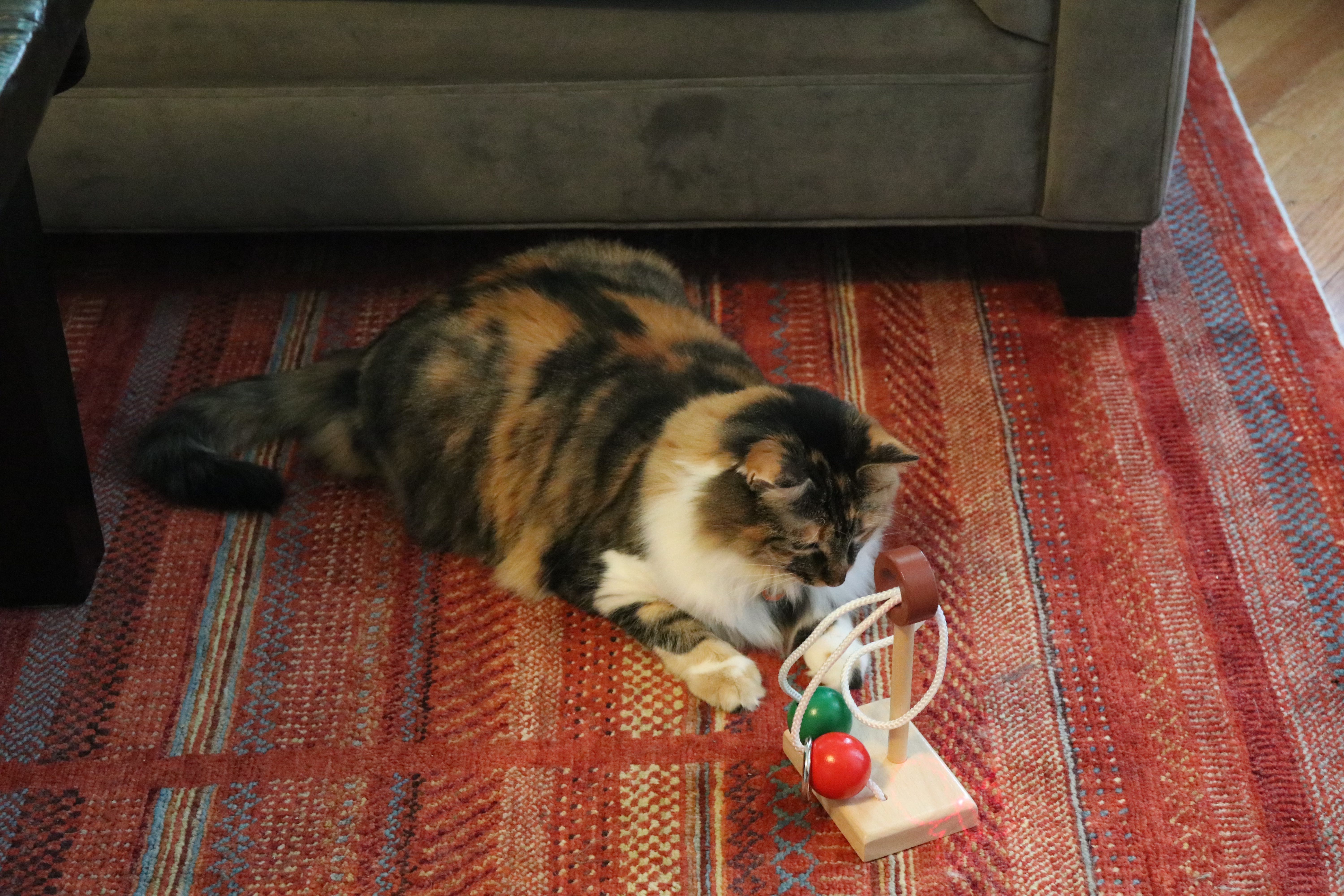
Not all rope puzzles are difficult for people. Consider the image above, which shows a second puzzle that is just slightly, but critically, different from the hard one. If you look at the picture and notice the difference, then I’m betting that you also saw the solution to this trivially easy puzzle by just looking at it. In contrast, most people, even after watching the solution video, cannot visualize the solution to the hard puzzle. It sort of slips out of one’s brain the moment they stop focusing on it.
Relative difficulty
I don’t think any cat could ever solve even the easy puzzle. You might, maybe be able to train a cat to perform a series of actions that result in the puzzle being solved, but even then the cat would have no understanding of what it was doing. Even a simple change would likely leave the cat stuck again.
(If you’re objecting that cats have no hands and that’s why they can’t solve the puzzle, then just replace it with one involving pressing big buttons or pushing blocks around such that a human would see it as trivial, and something a cat would be physically capable of solving it, but it would still be beyond the cat’s comprehension.)
If our human level of intelligence allows us to easily grasp concepts that animals cannot comprehend at all, then it seems plausible, perhaps even likely, that there could exist higher levels of intelligence that regard our most baffling problems as trivial. Perhaps an artificial intelligence built at some point in the future would glance at our most perplexing problems and see the solutions as obvious in the same way that we see pushing a door open to be obvious. Such an AI might effortlessly conceive ideas and explanations that are permanently and fundamentally beyond human comprehension, just as even the simplest knot is beyond the cognitive grasp of a cat.
Beyond human understanding
Ironically, it’s difficult to get one’s head around the idea of an idea that you could never understand. It’s not something merely hard to understand or something that you’d just need to study for a long time. It would be something fundamentally impossible to understand. It’s even more confusing to imagine that such an idea could be both genuinely useful and completely obvious by the standards of some other, smarter intelligence.
I would very much like to say that we have logic and math, tools that would allow us to eventually understand anything in our universe. Sadly, I think that would be incorrect. Yes, we might be able to use math and logic to define and manipulate ideas that we find incomprehensible, but that would not really imply understanding.
Another reason to doubt the wishful notion that our logic and math might be a universal solution to understanding any possible thing is that we came up these tools to explain the way we experience the universe. If something is absolutely beyond our comprehension, then it’s not clear that the tools we created to express and manipulate the our ideas would be up to the task of explaining anything beyond what we understand.
The mathematician Kurt Gödel famously proved that our math and logic do have limits. His pair of “Incompleteness Theorems” show that, no matter how clever we get, there will always be truths that lie beyond the reach of any fixed set of formal rules. In other words, we already know there are truths beyond the scope of our intellectual tools. The only question is whether those truths are beyond all intellects, or if there might be minds more powerful than ours that can grasp what we cannot.
An interesting corollary might be whether our AI systems could eventually surpass us in reasoning ability to the same extent that humans surpass cats. It seems plausible, but our AI systems are built on human-designed math and logic. Maybe that’s a fundamental limitation. Part of the problem with talking about things humans can’t understand is that we don’t actually understand what we’re talking about.
Why would we expect otherwise?
Notes:
I’m not talking about religious explanations, which would depend on faith. Faith is believing something despite there being no way to fully explain it or prove that it’s true. If it were possible for any level of intelligence to fully explain or prove something, then that thing would be mundane, not transcendent. In this article we are discussing our understanding of our mundane universe.
It seems apparent that both human and cat intelligence might vary from one individual to the next. Whatever that variation might be, it is relativly small compared to the difference between between, for example, cats and humans. The smartest cat can’t do multiplication, just like the smartest human can’t solve large n-body problems in their head. It might also be worth keeping in mind that “intelligence” is not one-dimensional. Someone terrible with logic might be great at spatial reasoning. For that matter, a typical cat probably has a much more advanced understanding of smells than anyone reading this article.
We already have programs that can solve rope and other puzzles by brute-force search of the puzzle’s configuration space. For example, rapidly-exploring random trees (RRT) are great for that sort of thing. However, brute-force search is like a person, or monkey, who just tries doing things until they stumble into a solution. Algorithms such as RRT are just clever ways of organizing a brute-force search. That’s different from being able to conceptually see and understand the solution.
About Me: James F. O’Brien is a Professor of Computer Science at the University of California, Berkeley. His research interests include computer graphics and animation, simulations of physical systems, human perception, machine learning, virtual reality, and the forensic analysis of images and video. O’Brien has collaborated with film and game companies, integrating advanced simulation physics into games and special effects. In 2015, he received an Academy Award for Technical Achievement for his work in special effects and destruction modeling.
Disclaimer: Any opinions expressed in this article are those of the author as a private individual. Nothing in this article should be interpreted as a statement made in relation to the author’s professional position with any institution.
This article and all embedded images are Copyright 2025 by the author. This article was written by a human, and both an LLM and other humans were used for proofreading and editorial suggestions.