
The Omni-Game Economy
When work disappears, what comes next?

Note: Most of the people who read early drafts of this article initially thought the idea sounded silly, and at first glance, it does. Paying people for structured play is an unusual proposal, but I think it deserves open-minded consideration. When I started teaching Computer Science at UC Berkeley nearly thirty years ago, much of the technology we take for granted today would have sounded absurd. What matters is not whether this proposal sounds strange now, but whether something like it may become necessary in the automated economy we are rapidly building, one where most human labor might no longer be needed. If you think I’m missing something obvious, I would genuinely welcome your thoughts in the comments.
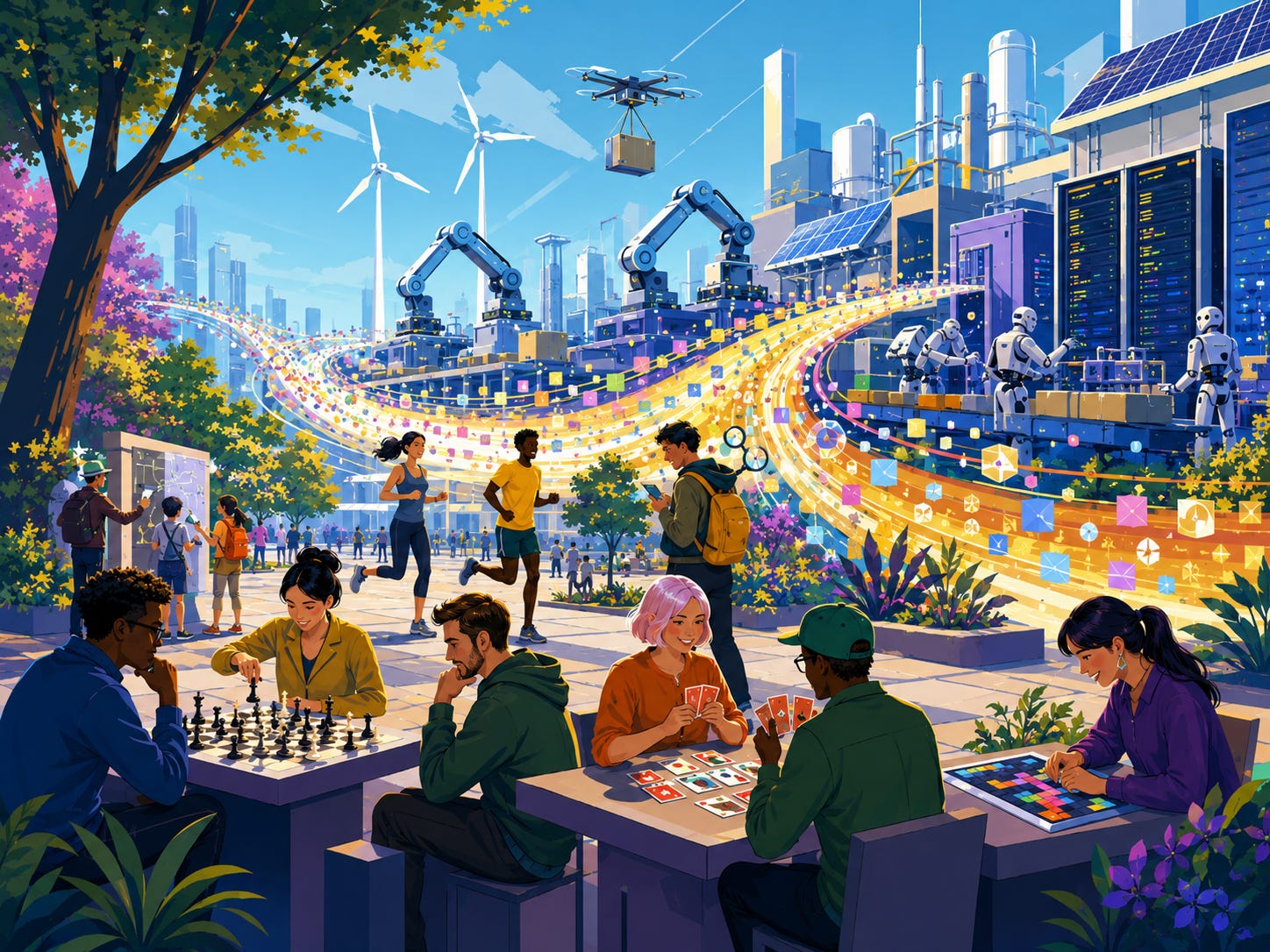
The prospect of widespread unemployment still feels both frightening and surreal. Most people in the United States have spent their lives assuming there would always be some kind of job available. Even in a weak economy, fallback work, though unpleasant, has been seen as a last resort. Our entire economic system is built on the assumption that nearly everyone will work, and that government support is needed only for a relatively small minority.
However, that assumption is being challenged. Artificial Intelligence (AI) has been eliminating jobs at an accelerating pace. Early effects were concentrated in entry-level roles, but that is changing as AI systems become capable of taking on more complex tasks. Predictions that AI advances would plateau have not held up. The idea that AI would create enough new jobs to offset the losses has also failed to materialize. New roles have emerged, but far fewer than the ones being eliminated.
It is difficult for many of us to accept the possibility that our basic assumption of being able to work could fail. Even when the trends are clear, many people insist there will be something that allows us to keep things more or less as they are. The idea of 80 or 90 percent unemployment sounds more like the premise of a science fiction story than something that could really happen. It seems unbelievable.
However, if we look back even just twenty years, many things that once sounded like improbable science fiction have become part of everyday life. Insisting that massive unemployment cannot happen simply because it is upsetting and sounds crazy will not prevent it. Worse, if we ignore the developing problem, then we lose the opportunity to prepare and perhaps avoid the worst consequences. We should prepare for the worst, even if we hold out hope for the best.
The solution outlined here, paying people to play games, also sounds like science fiction. However, I’m not writing this as a story concept. It is a serious proposal for a non-government-supported version of Universal Basic Income (UBI) that many people could depend on.
The key assumption is a large one, but I believe it is inevitable: AI and robotics will advance to the point where machines will be able to do nearly any task more effectively and more efficiently than humans can. That would mean most people will be unable to find paid work, since anyone needing a task completed would have the better and cheaper option of using a machine. If that does turn out to be the case, then the logical conclusion would be massive unemployment.
At the same time, the advent of machines that can do almost anything a human could do, including building more machines, also implies that the cost of nearly everything would fall to a small fraction of current costs. In the past, unemployment meant decreased production because people were idle. However, if machines are doing the work, then we’d actually see increases in production. Unlike economic crises of the past, the problem would not be scarcity or a lack of productivity. Instead, there would be a surplus. The problem would be how to share that surplus in a realistic and reasonable way.
Again, this prediction may sound implausible, but that is not a reason to dismiss it. We can debate how soon full AI automation will arrive, but few credible experts believe the trend with simply stop. Whether it is two years away or twelve, we will need a solution. Moreover, in light of the growing waves of layoffs and entry-level unemployment, it seems likely that we will need a solution sooner rather than later.
The idea of Universal Basic Income (UBI) funded by taxes has been suggested by many, including myself, but it relies on the government to accomplish some complex financial and social engineering. Unfortunately, it’s not clear that we can rely on our governments to get this right. In either case, government-funded UBI and this proposal are not mutually exclusive.
This Omni-Game proposal is about building an alternative form of UBI that distributes wealth based on what I’m calling “games”. To be clear, these are not just video games, or even things that most people would normally think of as games. They are structured human activities that exist specifically for this purpose and exclude machine competition by design. The goal is to create something like jobs that are safe from automation and to consider how such a system could be funded privately.
There is also an issue of human nature that needs to be accounted for. A loss of employment does not only remove income, it also removes structure, status, challenge, and a productive outlet for ambition. Many people might thrive with financial security and open-ended leisure, but many others need goals, competition, and a sense of progress. In place of jobs, we need a way to support people while also providing positive, rewarding outlets for their energies.
Games That Pay
Think about how many people already make money from games. Not by selling games or streaming gameplay, but by participating in structured systems where play itself produces income. Again, the term “games” here does not mean just video games or things that are specifically intended to be contests or entertainment activities.
The first example that comes to mind is the “gold farmers” in World of Warcraft. These players grind for in-game gold and then sell it for real-world money. Blizzard officially bans selling in-game assets for real-world money, but a grey market still persists.
Other games embrace the idea of giving virtual property real-world value. Entropia Universe has a fixed exchange rate of 10 Project Entropia Dollars to 1 U.S. dollar, and players cash out regularly. Second Life does something similar with its Linden Dollar economy. The space game, EVE Online, has such a robust market that economists study it, and the destruction of virtual property in large space battles is sometimes valued in the hundreds of thousands of real dollars.
Those examples are role-playing and open-world video games, but they are not the only types of games where play produces income. So-called “casual games”, the kind you can play on your mobile phone to kill time, can also be ways to earn money. For example, apps like Mistplay and Swagbucks pay players small amounts for time spent on puzzle games or farming simulators. Solitaire Grand Harvest and Cash Giraffe are other examples where casual, non-immersive tasks convert into gift cards or cash.
Of course, gambling is perhaps one of the most familiar examples. In games such as poker, roulette, and horse racing, winners are paid by the game. Even when the money comes from other players, the prize is structured by the game itself. In tournaments, the payout is even clearer. The champions win set prizes, and it hardly matters whether the prize money came from entry fees, ticket sales, or a sponsor. The payouts are determined by the rules of the games.
The stock market is also a kind of game. In principle, it allocates capital to businesses, but most players simply want to make winning bets. For many, the nature of the actual asset matters only insofar as it helps predict which prices will rise or fall. Bitcoin is the ultimate tradable asset in that it only exists to be traded. It has no asset-holding company behind it, no tangible commodity. Its value is nothing more than a balance number assigned to a wallet address that everyone agrees to treat as meaningful.
Prediction markets like Kalshi and Polymarket make the game-like nature of financial markets clear. In these prediction markets, players trade contracts that are simply bets on some verifiable outcome. There is no underlying value or commodity. Like derivatives markets, even if the contract is based on the price of something with tangible value, the contract in the prediction market itself is just a bet.
The Common Losing Thread
None of these paying games exist only for the benefit of the players. In nearly all cases, most players lose, and their losses support the system. Video games generate profit for the companies that run them. Casinos always come out ahead. Player-versus-player games, such as poker, might be zero-sum in theory, but in practice, the house or some organizing entity always takes a cut. Prediction markets have a balanced winner and loser for each contract, but the platform also takes its trading fees.
The stock market is a partial exception because companies can create genuine value. But even there, much of the movement in stock prices is speculation. A stock doubles overnight on an announcement, but no actual doubling of physical resources has occurred. The price moves because the players collectively agree that it should. The total capitalization in the stock market is far greater than the liquidation value of the underlying assets, and if the players ever decide to stop the game, then there would be a crash and the net losers would emerge. As mentioned, bitcoin is the extreme case: its value is entirely dependent on layers of collective consensus and if the game stopped, then the value would vanish completely.
Advertising supports many games, and in some cases, it might appear that players walk away with a net win. But game advertising exists to get players to spend money on products and services. A few savvy players might work the system and come out ahead, but for most, the money they ultimately spend in response to the advertising is greater than what they earn from the game. If it were not, then advertisers would learn to stop wasting money on net-negative ads.
The UBI Problem
If AI and robotics eliminate most jobs, how will people survive? In a world where most things can be done by machines, what happens to people who aren’t able to outperform or underprice machines? If the machines reach superhuman levels of performance at subhuman costs, what happens to the people who do not own machines that can work for them?
For many futurists, the obvious answer is UBI, paid by the government and funded through taxes. In the past, I’ve suggested that UBI might even be paid by taxing AI work in some way. Senator Bernie Sanders has recently proposed that the government should take partial ownership of AI companies and use the profits to fund UBI.
I think a system of tax-based UBI is possible, but history shows how difficult redistribution by taxation is to sustain. A working UBI system also requires careful design and thoughtful implementation, neither of which currently appear to be legislative strong points. (To be clear, this is not a comment about any particular party or administration. Rather, it is a comment on governments in general.)
So what if, instead of relying on taxation, we built a system of games that exist to pay people? Unlike games we have today, where the intent is to extract money from the players, these games would be designed to be net payers to the players.
UBI also does not address the human need for activity and challenge. Some portion of the population might be content to simply exist peacefully, but there are many others who crave challenge and competition. A monthly check may solve the problem of survival, but it does not by itself give people roles, status, achievement, or meaningful challenges. Those things matter too, and ignoring fundamental human nature would leave a large part of the post-work problem unsolved.
Science-fiction tropes like forced medication, draconian policing, or leaving people to languish in a disregarded underclass are dystopian and not part of a reasonable solution.
Why Call Them Games Instead of Jobs?
If people perform these activities for a living, even if the activities are fun, then technically we might consider them to be work as part of a job. But the distinction between these activities and the work we have today, and the reason I call them “games”, is because they are tasks where there is no economic incentive to use machines to do them.
If robots can build houses, cook meals, or write music better and cheaper than people, then those jobs will disappear. Hand-crafted work would still have value, and in a world of machine-produced commodities authentic work by humans would likely command a premium price. However, experience shows that many, perhaps most, people will opt for machine work if it is substantially cheaper.
The games, by contrast, exist precisely because they are useless economically. The company running them gains nothing from having bots slay dragons on its own servers or by having its own bots trade against each other in its prediction market. In fact, a top priority would be to keep bots out of the system.
An important part of this idea is that these games don’t preclude regular work or entrepreneurship. If a person is able to do something or make something that other people are interested in paying for, then they would still have that option. In fact, experience with UBI has shown that when people are freed from the need to work for others, many of them will find or create their own productive activities.
So, individuals could also find ways to produce something that others might value, such as handmade products or human-generated content. Both jobs and games could coexist in a single economy. However, while human-preferred jobs and demand for handmade products would be limited and still subject to competition with machines, the games would be available to anyone and explicitly shielded from machine competition.
The Omni-Game Concept
Picture an Omni-Game economy: a large and expanding collection of games of every type, all tied to a single game currency that can be freely exchanged for real money.
There would be no fees to play and no fees for converting currency. The purpose would be explicitly clear: to pay people enough that a full-time player could live reasonably comfortably on their earnings.
The catalog of games would be vast, varied, and ever-expanding. Players could play traditional video games where they slay dragons, battle other players, or wander valleys looking for rare virtual flowers. Casual games would pay people to farm plants or solve puzzles. Online activities people enjoy but that are not typically considered games could be gamified in engaging ways. Perhaps viewers would be paid a finder’s fee if they surfaced a video that later goes viral, or maybe based on the number of posts viewed. Casinos could be part of the Omni-Game, but with odds tilted toward the players so that habitual play would generate income rather than drain it.
Physical-world activities would also be included. Players could engage in poker tournaments, sports matches, scavenger hunts, or other real-world activities that all pay out in the same game currency. In addition to competitive or challenging activities, people could be paid for non-competitive activities, such as exercise or exploring nature trails.
Various markets would let people trade and speculate on both real and imaginary assets with game money. These might be similar to current prediction markets, except that they would be mediated by the platform at no cost. Rather than collecting trading fees, platforms might actually inject money into the markets. These markets and other trading activities might not look or feel like games to many players, but ultimately that would be exactly what they are.
Work vs. Play That Pays
It is important to distinguish between making money by playing a game and being paid to play. On the surface, these might sound like the same thing, but they are different.
Being paid because someone enjoys watching you, whether it’s professional football, a League of Legends tournament, or streaming Call of Duty, is work. It might be fun work, but it is still labor done because someone sees value in the result of the labor. Just like acting or influencing, it depends on an audience who either pays to watch or watches advertising that in turn pays the performers. We already see virtual AI performers competing for audience share, so being paid to play a game is no safer from AI competition than any other type of job.
Likewise, if a game needs to be played for some practical reason, paying people to do it is also work. If there is utility, then there would be an incentive to let machines do the work more efficiently and cheaply than humans.
The Omni-Game is different. It is not work in disguise. Its games are designed to be intentionally economically unproductive but psychologically and socially meaningful. It is a collection of tasks created specifically to be attractive to humans, to exclude machine players, and to pay the players for their efforts. Again, the games are not all video games. They could be literally any activity that a person could be paid to do, as long as there is no value in letting a machine do it instead.
The Omni-Game Criteria
The Omni-Game system and the games comprising it would need to meet at least three requirements. These criteria are not about abstract fairness or something similar. These criteria are necessary for the system to work and be stable:
1. A full-time player must be able to live reasonably on what they earn. Otherwise, the system fails at its primary purpose.
2. Greater earnings should require greater time, effort, skill, and/or luck. Humans are motivated by the potential for greater benefit, and the system needs some connection between what the players put in and what they can earn.
3. Games must provide challenge, growth, and outlets for safe competition. Otherwise, people will be bored and seek out destructive outlets.
Within those basic criteria, the games should be structured for people. Unlike real work, where tasks are determined by necessity and can be unpleasant, dangerous, or harmful to the worker, game tasks would be designed to be engaging and safe. They would be fun, rewarding, and include elements of healthy mental and physical challenge. Games could promote social interaction and cooperation, or provide quiet solitary focus. The games would be like what we would today call a “great job” because they would be designed specifically to be healthy and rewarding for people, and people would have wide freedom to select what they personally like.
Note that bogus “make-work” jobs, such as generating pointless bureaucratic paperwork or digging and refilling holes in the ground, would not solve the problem. Pointless work is neither challenging nor rewarding. Further, if there is a motivating pretense that the results of the make-work are necessary, then the pretense would also motivate having the work done by machine.
Sustainability
The Omni-Game operator will lose money by paying people to play. The costs might be offset slightly by advertising or by selling products to the players, but this system is specifically intended for the players to walk away with a surplus of earnings that they can use to fund their lives.
To be sustainable, the company or companies running the system will need to be generating more wealth than is being paid out to the players. From a capitalist perspective, it might look strange: robot factories and farms generating massive wealth, then selling it to people in exchange for game money that the people were given for playing made-up games. Instead of hoarding the wealth, the owners of the “capital” in the form of robots, servers, factories, and farms would be giving it away to people who just play games in return.
However, this is exactly what we need for the future. It seems clear that machines are going to be doing most work vastly more efficiently and cheaply than people can. Given that most people, perhaps as high as 85% of us, dislike our jobs, the prospect of letting machine do the drudge work is not inherently bad. The fundamental problem is that we still need a way to distribute the proceeds to people who need those resources to live. In a sense, we are adapting capitalism to remove the part where we expect people to be producing the value, and letting machines do the work instead.
Another fundamental change is the value of production itself. In a world where robots can build more robots, labor and most resources are essentially unlimited. Energy might seem like a limited resource at first, but when armies of robots can build square miles of solar panels, geothermal, hydro, and nuclear power plants, even that limit may fall away for all practical purposes.
How We Get There
This Omni-Game concept is just a fairy tale unless someone with the resources decides to make it happen. I don’t think it’s quite possible yet, but I think it will be soon. AI and robot technologies are advancing more rapidly than most people realize.
That raises an obvious question: why would someone want to do this?
The somewhat cynical answer is that if you control the Omni-Game, then you control the players. Ideally, that control would be exercised openly and benignly. In a world where corporations and billionaires with essentially unlimited resources compete with each other, the billionaire with the most players in their game will be the one who gets to add their face to Mt. Rushmore.
A less cynical perspective is that most of us feel good when we help others and receive positive sentiment in return. A wealthy person who “has everything” might fund a museum, opera house, hospital, university, or other public good, because it is gratifying to be appreciated by people who benefit from it. A billionaire could choose to live alone in an underground complex on a remote island, but most of them seem to prefer to engage with the world.
It’s very easy to find accounts of ultra-wealthy individuals, even notorious criminals, who took pride in taking care of “their people” and craved positive societal recognition. Another comparison would be to royalty who feel a duty to do what’s best for their subjects. History is full of abusive examples, but also positive ones. Without the pressure of needing people to produce further wealth, and with people free to move over to someone else’s Omni-Game, I’m hopeful that the negative aspects of the power relationship would be no worse, and perhaps much better, than what we see today with both governance and employment.
Perhaps the system will be built by a single company, multi-billionaire, or a conglomerate of such. Groups of people might join together to form collectives. Maybe governments will manage to make something happen through laws and taxes.
It also seems likely that there would be more than one Omni-Game system and that they might compete with each other for players and the political power that ultimately comes from those players. Open competition is one way that we might avoid some of the dystopian possibilities.
The specific design and choices would matter. Designed badly, the result would be more like the dystopian worlds of “Ready Player One” or “Black Mirror” than a world where any of us want to live. But designed well, it could be a humane system that frees people from many of the pressures created by today’s economy
Again, to be clear, this is not about VR escapism or video game immersion. It is about creating a structured system of rewarding human activity across many different modalities, including traditional physical ones. The explicit purpose would be to provide income-generating tasks when machines no longer need us for economically productive work. Many games would not look or feel like what most people consider games, but they would still serve the purpose of creating activities that only have value when performed by humans.
Many people looking today at the shrinking job market and growing capabilities of AI software and robot hardware are understandably worried. Some radical change needs to happen, or else we will continue down a path that looks increasingly dystopian.
The good news is that building something like an Omni-Game is not impossible, and, given the benefits of controlling the system, it doesn’t completely depend on altruism. Whether built by governments, individuals, corporations, or coalitions, and whether there is only one system or several competing systems, something like the Omni-Game may be the most viable way to make sure people can live when the world no longer need our labor.
About Me: James F. O’Brien is a Professor of Computer Science at the University of California, Berkeley. His research interests include computer graphics, computer animation, artificial intelligence, simulations of physical systems, human perception, rendering, image synthesis, machine learning, virtual reality, digital privacy, and the forensic analysis of images and video.
If you would like to read my other articles, consider subscribing. You can also find me on LinkedIn, Instagram, and at UC Berkeley.
Disclaimer: Any opinions expressed in this article are only those of the author as a private individual. Nothing in this article should be interpreted as a statement made in relation to the author’s professional position with any institution.
This article and all embedded images are Copyright 2026 by the author. This article was written by a human, and both an LLM and other humans were used for proofreading and editorial suggestions.